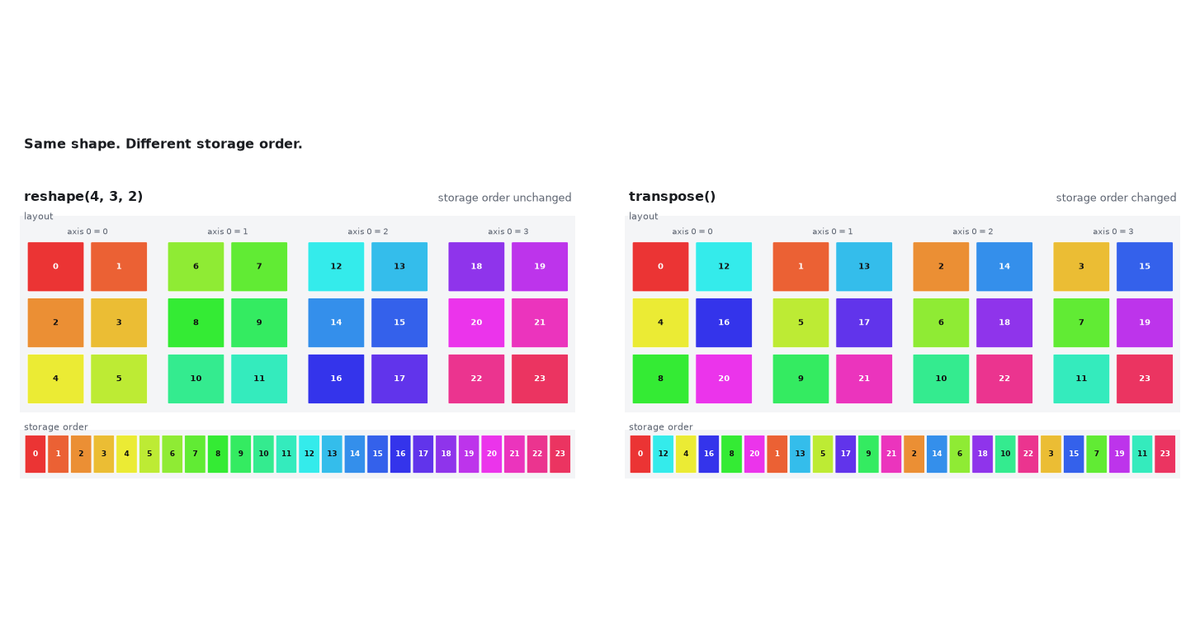
Nested Python lists already hold a grid. They do not carry a shape we can reshape. A tiny class that stores a flat list and a shape tuple gives NumPy’s layout methods with no NumPy.
We already write nested lists and call len for the first axis. The other axes are nested loops. NumPy’s .shape is that layout made explicit. shape, ndim, and size are attributes, not calls.
1 Storage
This post uses a synthetic \(2\times 3\times 4\) array of range(24).
Provenance:
- The 24 integers are generated, not measured.
- The array stands in for a small 3-way table (batch × row × column).
- Size 24 was chosen so each entry can keep one colour in the figures.
- A measured table of that shape is larger; the layout questions are the same.
The constructor flattens nested lists and records a shape. It rejects a shape whose product is not len(data).
from math import prod


def _flatten_shape(data):
    if not isinstance(data, list):
        return [data], ()
    if not data:
        return [], (0,)
    parts = [_flatten_shape(item) for item in data]
    shape = parts[0][1]
    if any(s != shape for _, s in parts):
        raise ValueError("ragged nested list")
    flat = [v for f, _ in parts for v in f]
    return flat, (len(data),) + shape


def _unravel(index, shape):
    out = []
    for size in reversed(shape):
        out.append(index % size)
        index //= size
    return tuple(reversed(out))


def _ravel(multi, shape):
    index = 0
    for i, n in zip(multi, shape):
        index = index * n + i
    return index


def _pad_key(key, ndim):
    if not isinstance(key, tuple):
        key = (key,)
    if key.count(Ellipsis) > 1:
        raise IndexError("at most one ellipsis")
    if Ellipsis in key:
        loc = key.index(Ellipsis)
        n_fill = ndim - (len(key) - 1)
        if n_fill < 0:
            raise IndexError("too many indices")
        key = key[:loc] + (slice(None),) * n_fill + key[loc + 1 :]
    if len(key) > ndim:
        raise IndexError("too many indices")
    if len(key) < ndim:
        key = key + (slice(None),) * (ndim - len(key))
    return key


def _axis_int(i, n):
    if isinstance(i, bool) or not isinstance(i, int):
        raise TypeError("integer index expected")
    if i < 0:
        i += n
    if i < 0 or i >= n:
        raise IndexError("index out of bounds")
    return i


class Tensor:
    def __init__(self, data, shape=None):
        if shape is None:
            data, shape = _flatten_shape(data)
        data = list(data)
        shape = tuple(shape)
        if prod(shape) != len(data):
            raise ValueError("shape does not match size")
        self._data = data
        self._shape = shape
2 Counts
Four numbers describe the same layout:
- shape — length of each axis:
(2, 3, 4). - ndim — how many axes:
3. - size — product of the shape:
24. - len — first axis only:
2, not24.
    @property
    def shape(self):
        return self._shape

    @property
    def ndim(self):
        return len(self._shape)

    @property
    def size(self):
        return prod(self._shape)

    def __len__(self):
        return self._shape[0]
3 Reshape
reshape returns a new Tensor with the same _data and a new shape. The product must equal .size. The list is copied; this is not a NumPy view.
    def reshape(self, *shape):
        if prod(shape) != self.size:
            raise ValueError("size mismatch")
        return Tensor(self._data, shape)
Each colour is one entry. The strip is storage order.
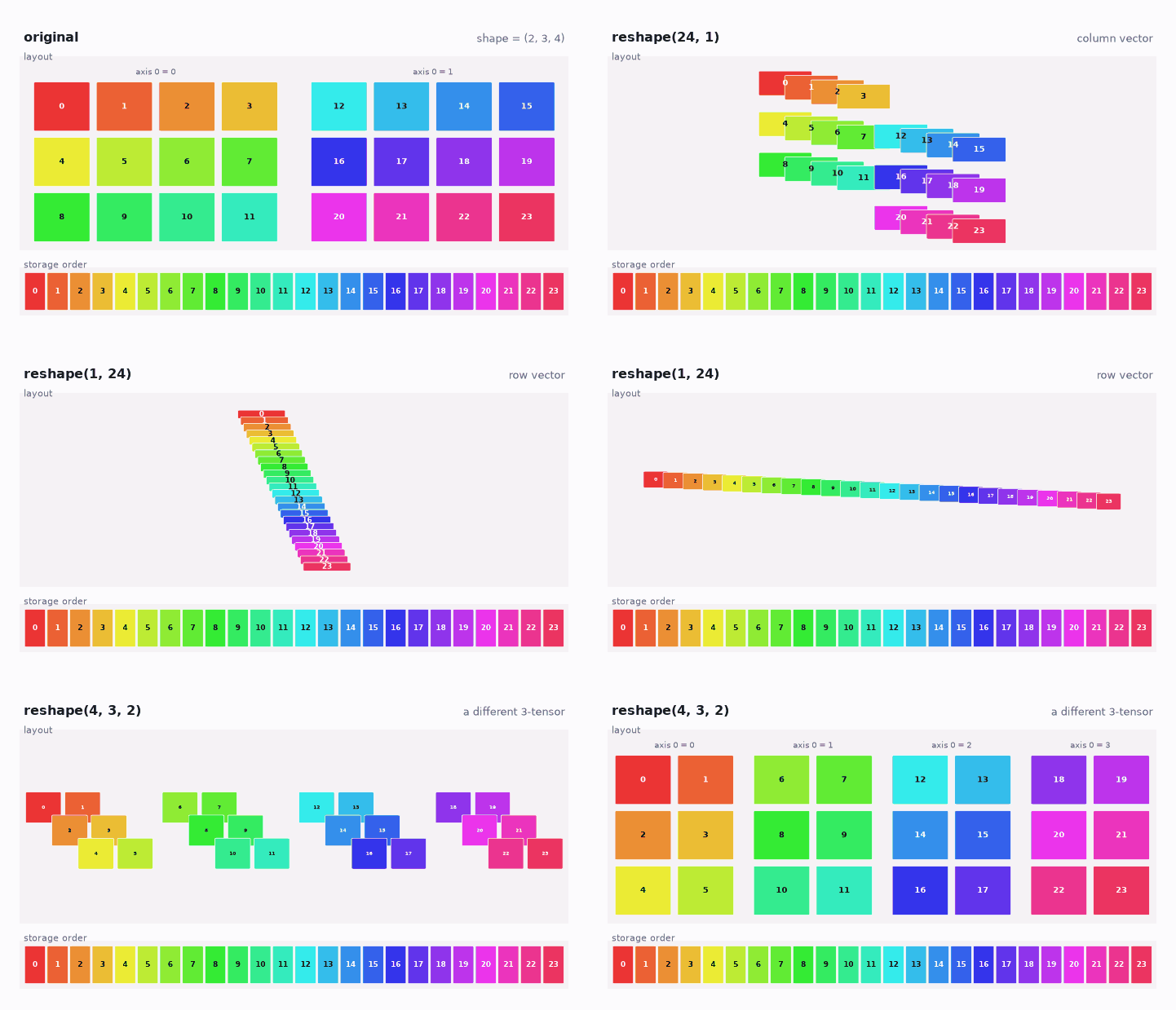
reshape to a column, a row, and a \(4\times 3\times 2\). The storage strip stays 0 through 23.
The column, the row, and the \(4\times 3\times 2\) keep that order.
4 Transpose
Default transpose reverses axes. \((2, 3, 4)\) becomes \((4, 3, 2)\). Each multi-index is permuted and written into a new flat list.
    def transpose(self, *axes):
        if not axes:
            axes = tuple(range(self.ndim - 1, -1, -1))
        new_shape = tuple(self._shape[a] for a in axes)
        out = [None] * self.size
        for i, value in enumerate(self._data):
            old = _unravel(i, self._shape)
            new = tuple(old[a] for a in axes)
            out[_ravel(new, new_shape)] = value
        return Tensor(out, new_shape)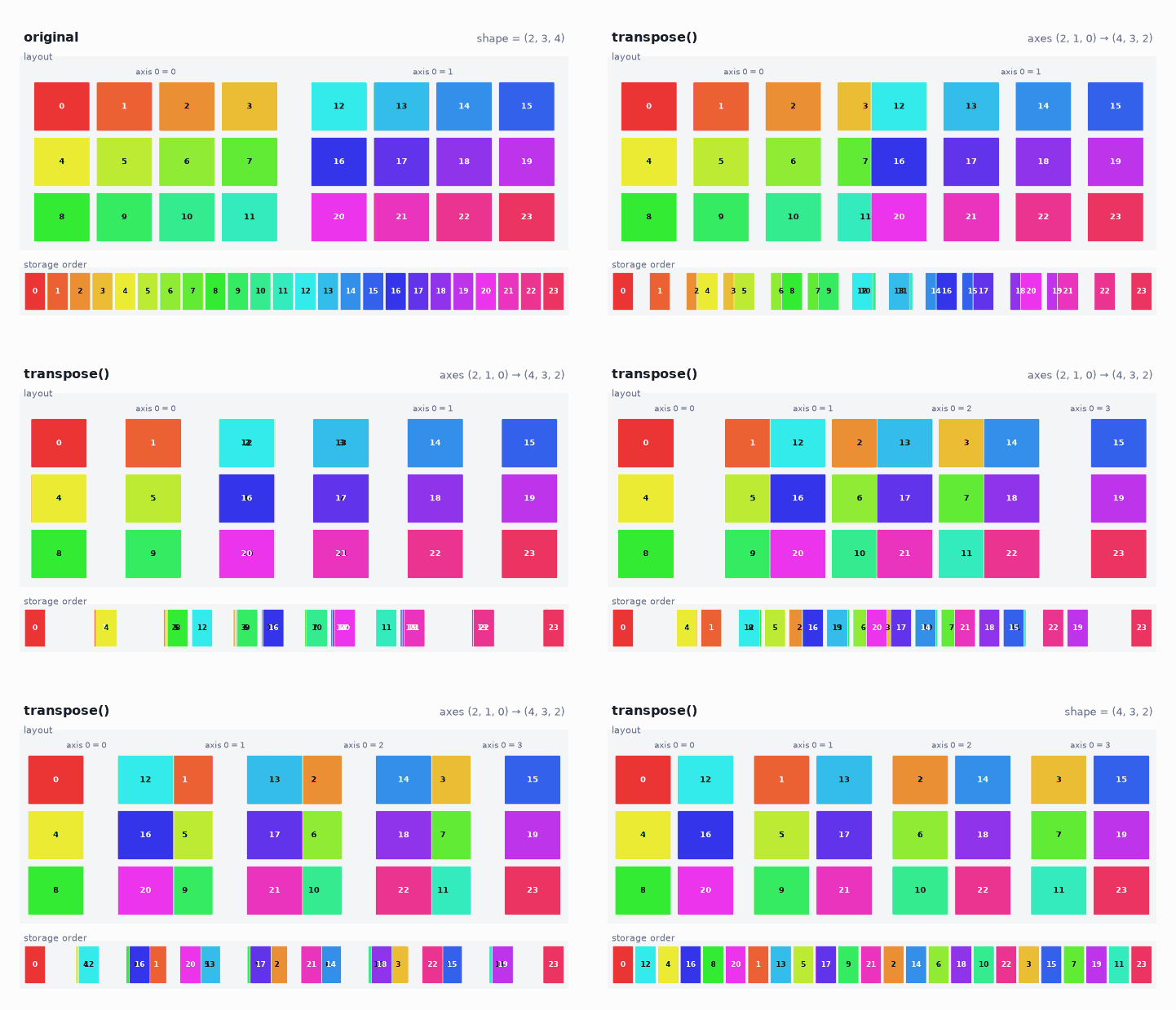
transpose. Layout is \(4\times 3\times 2\); the storage strip is no longer 0 through 23.
The \(4\times 3\times 2\) box matches the last reshape. The strip does not.
5 Indexing
__getitem__ reads values. Three forms. Every result is a copy.
- Simple — an integer. That axis drops.
t[0]has shape(3, 4).t[0, 2, 3]is11. - Slicing — a
slice. That axis stays.t[:, 1]is the middle row of both batches, shape(2, 4).t[0, :2, 1:3]has shape(2, 2). - Fancy — a list of integers gathers those positions.
t[[0, 1]]is both batches. Two lists pick pairs, not a grid:t[[0, 1], [2, 0], 0]is[8, 12]. The \(2\times 2\) block is a slice:t[:2, :2, 0].
    def __getitem__(self, key):
        key = _pad_key(key, self.ndim)
        kinds = []
        coords = []
        for k, n in zip(key, self._shape):
            if isinstance(k, list):
                coords.append([_axis_int(i, n) for i in k])
                kinds.append("fancy")
            elif isinstance(k, slice):
                coords.append(list(range(*k.indices(n))))
                kinds.append("slice")
            elif isinstance(k, int) and not isinstance(k, bool):
                coords.append([_axis_int(k, n)])
                kinds.append("int")
            else:
                raise TypeError("index must be an int, a slice, or a list of ints")

        fancy = [i for i, kind in enumerate(kinds) if kind == "fancy"]
        if fancy:
            length = len(coords[fancy[0]])
            if any(len(coords[i]) != length for i in fancy):
                raise IndexError("fancy lists must have the same length")
            if max(fancy) - min(fancy) + 1 != len(fancy):
                raise IndexError("fancy axes must be adjacent")

        out_shape = []
        ax = 0
        while ax < self.ndim:
            if fancy and ax == min(fancy):
                out_shape.append(length)
                ax = max(fancy) + 1
                continue
            if kinds[ax] == "slice":
                out_shape.append(len(coords[ax]))
            ax += 1
        out_shape = tuple(out_shape)

        data = []

        def fill(ax, p, multi):
            if ax == self.ndim:
                data.append(self._data[_ravel(tuple(multi), self._shape)])
                return
            kind = kinds[ax]
            if kind == "int":
                fill(ax + 1, p, multi + [coords[ax][0]])
            elif kind == "slice":
                for i in coords[ax]:
                    fill(ax + 1, p, multi + [i])
            elif ax == min(fancy):
                for q in range(length):
                    fill(ax + 1, q, multi + [coords[ax][q]])
            else:
                fill(ax + 1, p, multi + [coords[ax][p]])

        fill(0, None, [])
        if not out_shape:
            return data[0]
        return Tensor(data, out_shape)
6 Constraints
No broadcasting, no boolean mask, no newaxis, no views. Fancy axes must be adjacent. Enough to see why NumPy treats shape as data. NumPy to JAX is the real API.
7 Class
Markdown fences do not join. reshape, transpose, and __getitem__ are ordinary methods on Tensor:
from math import prod


def _flatten_shape(data):
    if not isinstance(data, list):
        return [data], ()
    if not data:
        return [], (0,)
    parts = [_flatten_shape(item) for item in data]
    shape = parts[0][1]
    if any(s != shape for _, s in parts):
        raise ValueError("ragged nested list")
    flat = [v for f, _ in parts for v in f]
    return flat, (len(data),) + shape


def _unravel(index, shape):
    out = []
    for size in reversed(shape):
        out.append(index % size)
        index //= size
    return tuple(reversed(out))


def _ravel(multi, shape):
    index = 0
    for i, n in zip(multi, shape):
        index = index * n + i
    return index


def _pad_key(key, ndim):
    if not isinstance(key, tuple):
        key = (key,)
    if key.count(Ellipsis) > 1:
        raise IndexError("at most one ellipsis")
    if Ellipsis in key:
        loc = key.index(Ellipsis)
        n_fill = ndim - (len(key) - 1)
        if n_fill < 0:
            raise IndexError("too many indices")
        key = key[:loc] + (slice(None),) * n_fill + key[loc + 1 :]
    if len(key) > ndim:
        raise IndexError("too many indices")
    if len(key) < ndim:
        key = key + (slice(None),) * (ndim - len(key))
    return key


def _axis_int(i, n):
    if isinstance(i, bool) or not isinstance(i, int):
        raise TypeError("integer index expected")
    if i < 0:
        i += n
    if i < 0 or i >= n:
        raise IndexError("index out of bounds")
    return i


class Tensor:
    def __init__(self, data, shape=None):
        if shape is None:
            data, shape = _flatten_shape(data)
        data = list(data)
        shape = tuple(shape)
        if prod(shape) != len(data):
            raise ValueError("shape does not match size")
        self._data = data
        self._shape = shape

    @property
    def shape(self):
        return self._shape

    @property
    def ndim(self):
        return len(self._shape)

    @property
    def size(self):
        return prod(self._shape)

    def __len__(self):
        return self._shape[0]

    def reshape(self, *shape):
        if prod(shape) != self.size:
            raise ValueError("size mismatch")
        return Tensor(self._data, shape)

    def transpose(self, *axes):
        if not axes:
            axes = tuple(range(self.ndim - 1, -1, -1))
        new_shape = tuple(self._shape[a] for a in axes)
        out = [None] * self.size
        for i, value in enumerate(self._data):
            old = _unravel(i, self._shape)
            new = tuple(old[a] for a in axes)
            out[_ravel(new, new_shape)] = value
        return Tensor(out, new_shape)

    def __getitem__(self, key):
        key = _pad_key(key, self.ndim)
        kinds = []
        coords = []
        for k, n in zip(key, self._shape):
            if isinstance(k, list):
                coords.append([_axis_int(i, n) for i in k])
                kinds.append("fancy")
            elif isinstance(k, slice):
                coords.append(list(range(*k.indices(n))))
                kinds.append("slice")
            elif isinstance(k, int) and not isinstance(k, bool):
                coords.append([_axis_int(k, n)])
                kinds.append("int")
            else:
                raise TypeError("index must be an int, a slice, or a list of ints")

        fancy = [i for i, kind in enumerate(kinds) if kind == "fancy"]
        if fancy:
            length = len(coords[fancy[0]])
            if any(len(coords[i]) != length for i in fancy):
                raise IndexError("fancy lists must have the same length")
            if max(fancy) - min(fancy) + 1 != len(fancy):
                raise IndexError("fancy axes must be adjacent")

        out_shape = []
        ax = 0
        while ax < self.ndim:
            if fancy and ax == min(fancy):
                out_shape.append(length)
                ax = max(fancy) + 1
                continue
            if kinds[ax] == "slice":
                out_shape.append(len(coords[ax]))
            ax += 1
        out_shape = tuple(out_shape)

        data = []

        def fill(ax, p, multi):
            if ax == self.ndim:
                data.append(self._data[_ravel(tuple(multi), self._shape)])
                return
            kind = kinds[ax]
            if kind == "int":
                fill(ax + 1, p, multi + [coords[ax][0]])
            elif kind == "slice":
                for i in coords[ax]:
                    fill(ax + 1, p, multi + [i])
            elif ax == min(fancy):
                for q in range(length):
                    fill(ax + 1, q, multi + [coords[ax][q]])
            else:
                fill(ax + 1, p, multi + [coords[ax][p]])

        fill(0, None, [])
        if not out_shape:
            return data[0]
        return Tensor(data, out_shape)


t = Tensor(list(range(24)), (2, 3, 4))
assert t.shape == (2, 3, 4)
assert len(t) == 2
assert t.reshape(4, 3, 2)._data == t._data
assert t.transpose()._data != t._data
assert t[0, 2, 3] == 11
assert t[:, 1].shape == (2, 4)
assert t[[0, 1], [2, 0], 0]._data == [8, 12]
assert t[:2, :2, 0].shape == (2, 2)
Storage. Order. Survives. Reshape. Transpose. Breaks. It. Indexing. Copies. Out.
8 References
- NumPy, The N-dimensional array (
ndarray). - NumPy, Indexing on ndarrays.
- NumPy to JAX — this blog;
shape,ndim,size, andreshapeon the real array type.