Workshop companion

Videos, audio, diagrams, and practice questions

Review the workshop with these NotebookLM materials, generated 2026-09-07. They have not been checked by a person. Use the handbook to check answers.

The whole day in one picture

Four ideas connect the sections. This diagram was drawn by hand.

Four ideas, one object Every section serves one of these four ideas. It generalizes a matrix — 01 What a tensor is, 02 Thinking in N dimensions; It holds the data — 00 Setup and welcome, 03 Indexing and broadcasting real data, 05 Video pipeline design; Its axes can move — 04 Reshape and transpose real images, 06 Contraction with einsum; It factors — 07 Inverses and the pseudoinverse, 08 Recursion with matrices and vectors, 09 Matrix factorizations, 10 Tucker decomposition on real data, 11 Tensor factorizations, 14 CP factorization and the rank-1 view, 15 Generalized CP for counts and binary data. One thread runs through all four. When there is no exact answer, find the best approximation you can trust. 12 pulls the four together. 13 is the take-home. Four ideas, one object Every section serves one of these four ideas. It generalizes a matrix The same object, with as many axes as the data needs. 01 What a tensor is 02 Thinking in N dimensions It holds the data Images, video, taxi trips: one box of numbers. 00 Setup and welcome 03 Indexing and broadcasting real data 05 Video pipeline design Its axes can move reshape re-reads the numbers. transpose moves the axes. 04 Reshape and transpose real images 06 Contraction with einsum It factors Break it into simpler parts you can use. 07 Inverses and the pseudoinverse 08 Recursion with matrices and vectors 09 Matrix factorizations 10 Tucker decomposition on real data 11 Tensor factorizations 14 CP factorization and the rank-1 view 15 Generalized CP for counts and binary data One thread runs through all four. When there is no exact answer, find the best approximation you can trust. You watch it happen in sections 07, 10 and 13. 12 pulls the four together. 13 is the take-home. Four ideas, one object Every section serves one of these four ideas. It generalizes a matrix — 01 What a tensor is, 02 Thinking in N dimensions; It holds the data — 00 Setup and welcome, 03 Indexing and broadcasting real data, 05 Video pipeline design; Its axes can move — 04 Reshape and transpose real images, 06 Contraction with einsum; It factors — 07 Inverses and the pseudoinverse, 08 Recursion with matrices and vectors, 09 Matrix factorizations, 10 Tucker decomposition on real data, 11 Tensor factorizations, 14 CP factorization and the rank-1 view, 15 Generalized CP for counts and binary data. One thread runs through all four. When there is no exact answer, find the best approximation you can trust. 12 pulls the four together. 13 is the take-home. Four ideas, one object Every section serves one of these four ideas. It generalizes a matrix The same object, with as many axes as the data needs. 01 What a tensor is 02 Thinking in N dimensions It holds the data Images, video, taxi trips: one box of numbers. 00 Setup and welcome 03 Indexing and broadcasting real data 05 Video pipeline design Its axes can move reshape re-reads the numbers. transpose moves the axes. 04 Reshape and transpose real images 06 Contraction with einsum It factors Break it into simpler parts you can use. 07 Inverses and the pseudoinverse 08 Recursion with matrices and vectors 09 Matrix factorizations 10 Tucker decomposition on real data 11 Tensor factorizations 14 CP factorization and the rank-1 view 15 Generalized CP for counts and binary data One thread runs through all four. When there is no exact answer, find the best approximation you can trust. You watch it happen in sections 07, 10 and 13. 12 pulls the four together. 13 is the take-home.

Video overview

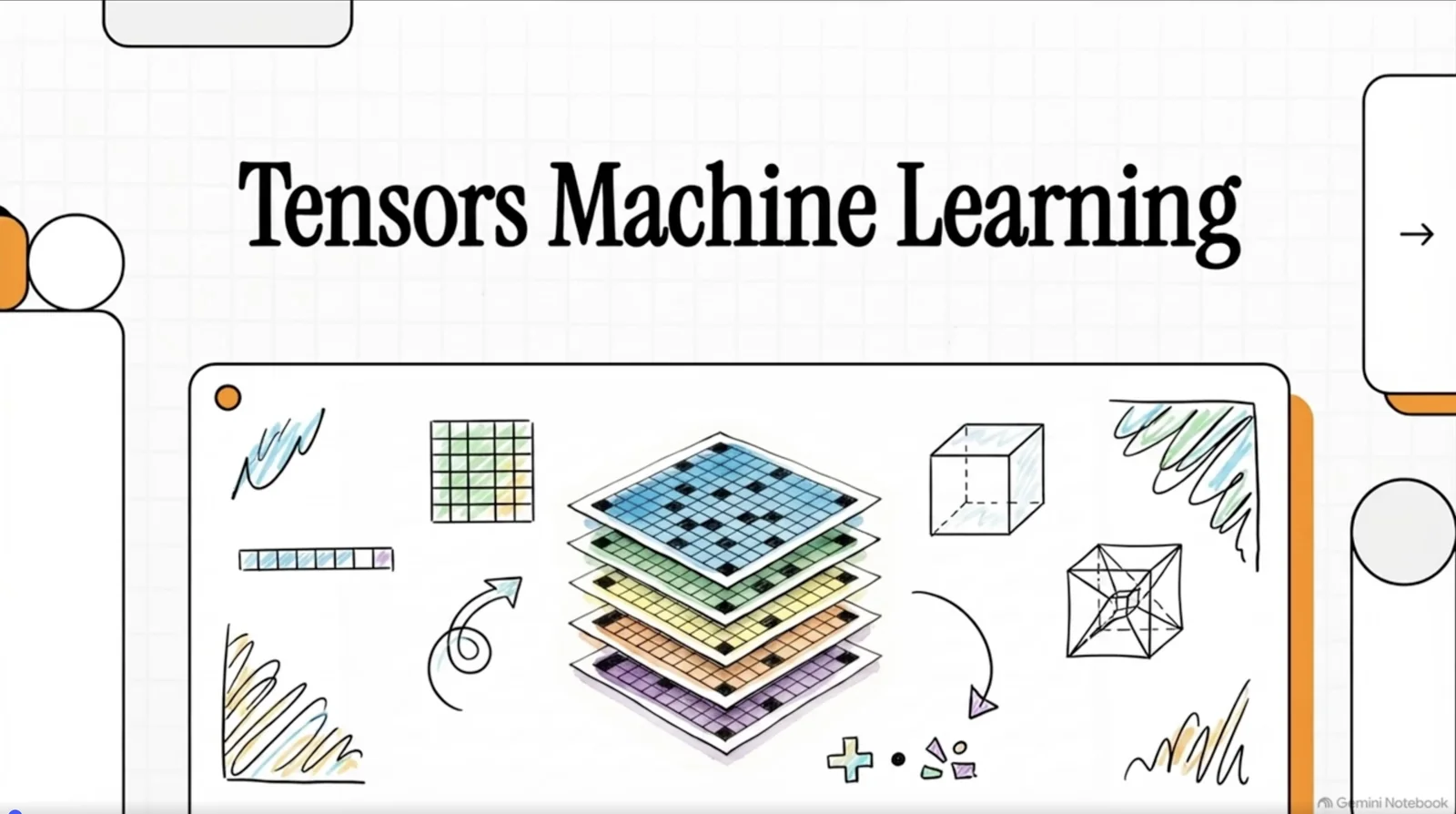
Watch the NotebookLM video: Tensors Machine Learning, illustrated with stacked tensor slices.

Tensors in machine learning — video overview — Watch in NotebookLM.

One-minute shorts

About a minute per idea. Opens in NotebookLM.

Infographics

View in NotebookLM:

Listen

Listen to two hosts explain the main ideas.

Audio overview — 2 minutes. Listen in NotebookLM.

Test yourself

Practice at your own pace. For the live quizzes, use Kahoot.

Open a preview to try the activity in NotebookLM.
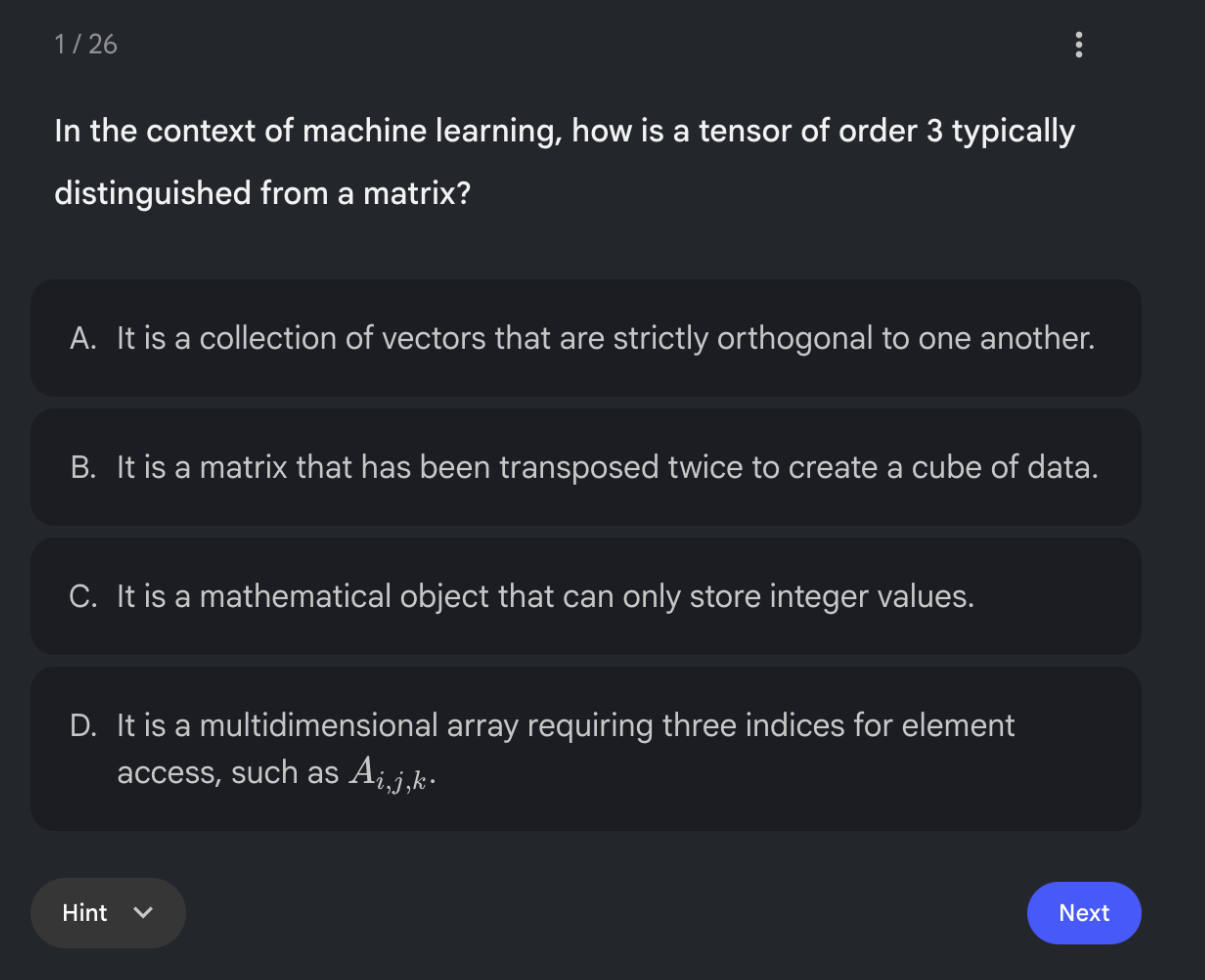
The first of the quiz's twenty-six questions, as NotebookLM shows it: how an order-3 tensor is distinguished from a matrix, with four answers lettered A to D and a Hint button beside Next.

Self-check quiz
26 multiple-choice questions.
Find what to review.
Opens in NotebookLM. Preview of the interactive activity.
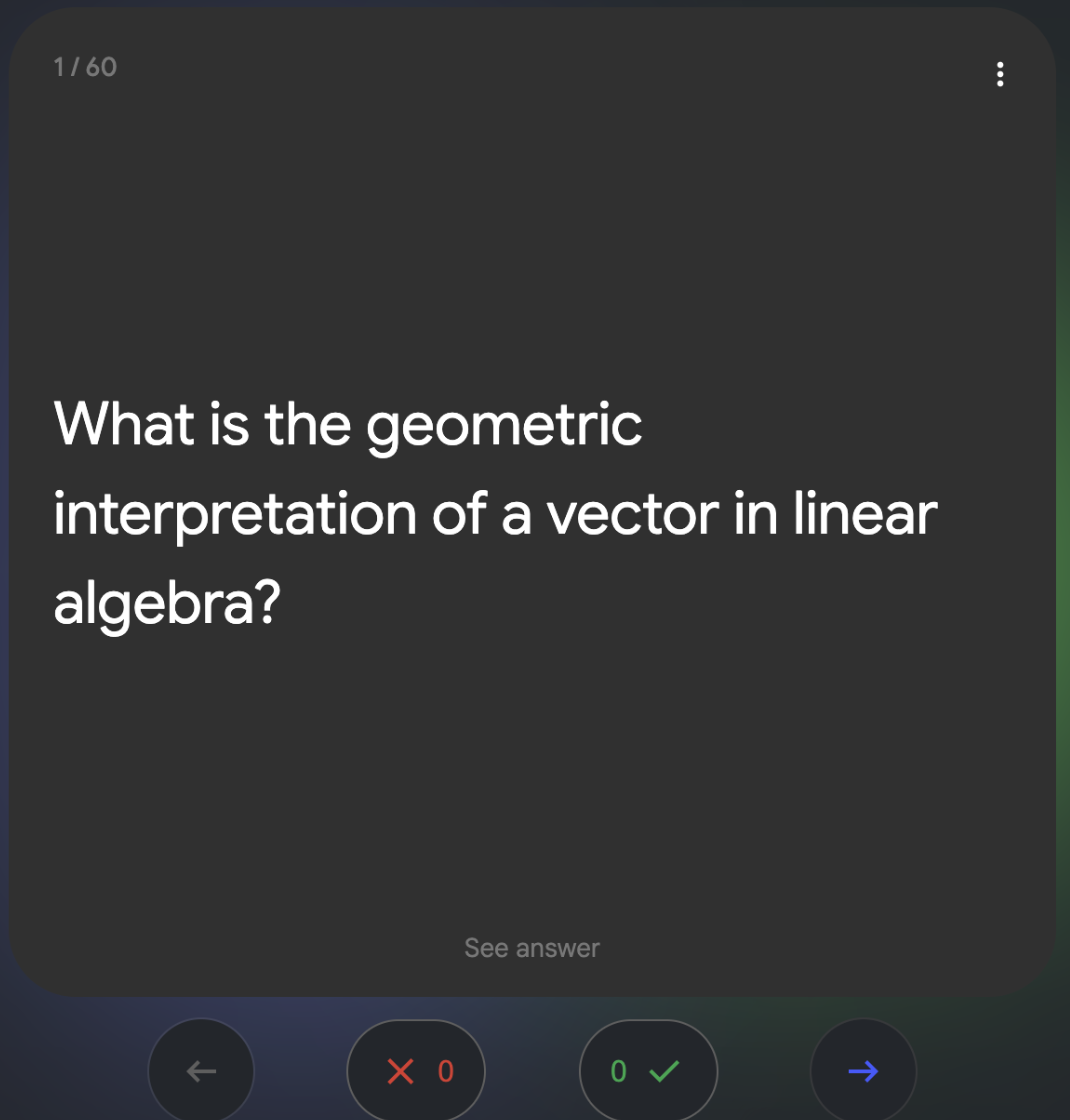
Card one of sixty, face up: what is the geometric interpretation of a vector in linear algebra, with a See answer prompt underneath and the got-it and missed-it counters below the card.

Flashcards
60 cards on linear algebra and tensors.
Practice recalling key ideas.
Opens in NotebookLM. Preview of the interactive activity.

The map

Open a preview to try the activity in NotebookLM.
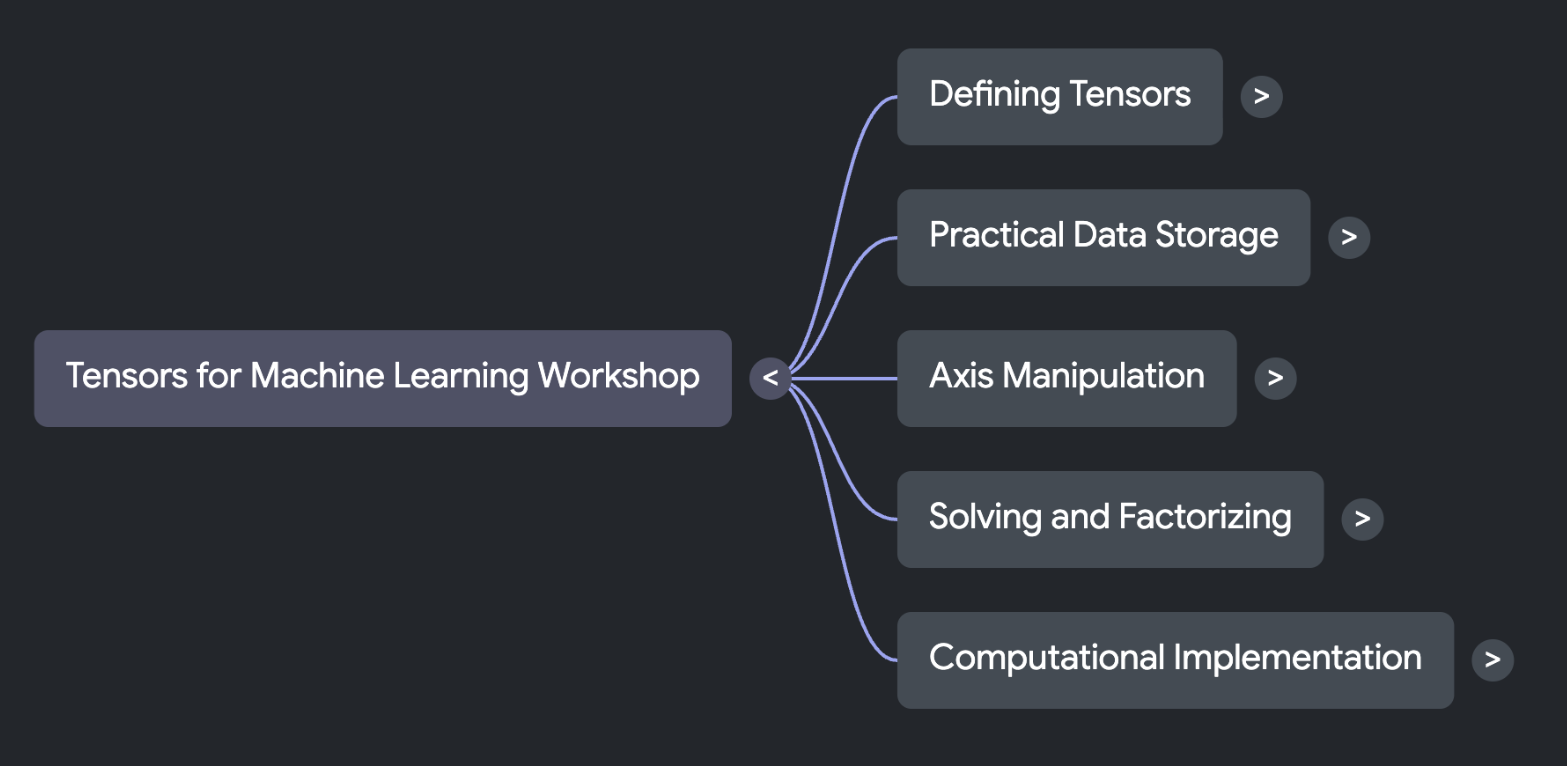
The mind map collapsed to its top level: a node reading Tensors for Machine Learning Workshop, with five branches curving off it — Defining Tensors, Practical Data Storage, Axis Manipulation, Solving and Factorizing, and Computational Implementation — each with an arrow that opens it further.

Mind map
Five branches connect the workshop’s ideas.
Expand a branch to explore.
Opens in NotebookLM. Preview of the interactive activity.
In NotebookLM

Open the notebook to explore the sources. View the overview infographic.