Part III: The Craft of Outputs
Quarto, reproducible publishing, coding agents, Markdown, Python, EPUB, data analysis, k-means clustering
Part II taught each format through one guide for a tourism office. This part is for the documents professionals are asked for, and it takes them one kind at a time, from one set of results: the evaluation that 3 The Fast Path started, in which Acme Signals, a fictional start-up, compares three releases of a model on real public data.
Each chapter teaches its output the same way (Vocabulary, specification, verification): the vocabulary of what the format can do, so that you can ask for it by name; a specification, a tested prompt and the rules that belong in AGENTS.md; and the verification that shows the result is right, from the diff, the render and the checks that run without you. You will rarely write a theme or a template by hand; you will often need to know that one exists, what to call it, and what a good one looks like.
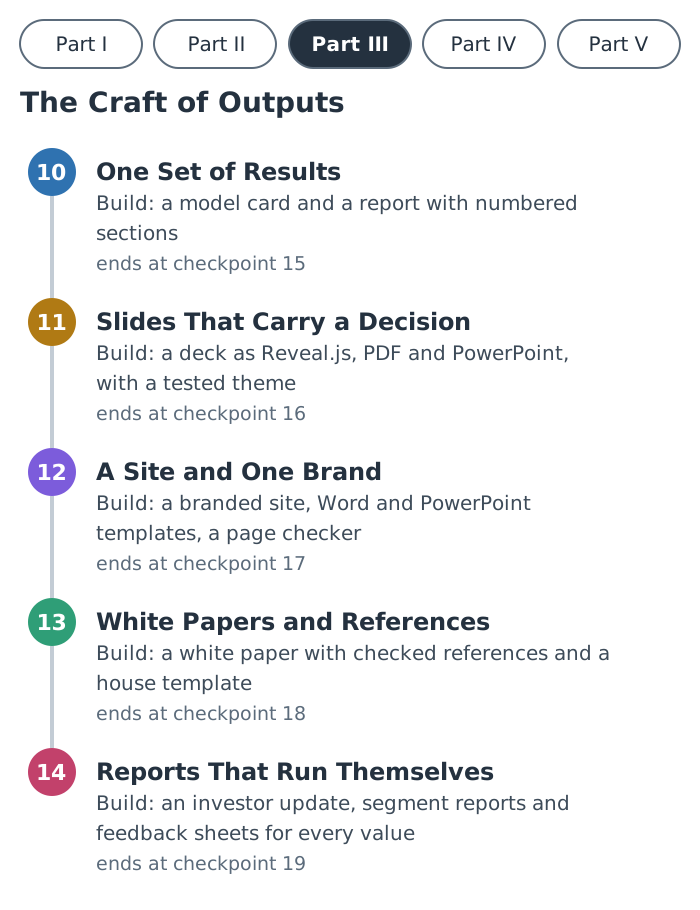
10 One Set of Results, One Set of Results. Why every result is computed once and read by every document, what tests, guards and the render each catch, and a model card written as one larger task, with a plan first and its checks after.
11 Slides That Carry a Decision, Slides That Carry a Decision. What makes a technical deck work, the Reveal.js features that serve it, a theme whose contrast a test checks, a PDF from print view, and the same deck in PowerPoint in a house template.
12 A Site and One Brand, A Site and One Brand. One brand file for the site, the deck and the PDFs, Word and PowerPoint templates made from it, a website with a home page, an About page and search, and a script that checks every page.
13 White Papers and References, White Papers and References. A paper that stands on its own outside the company: numbered sections, cross-referenced equations, tables and figures, citations in one style in every format, references a script confirms, and a house template for the PDF.
14 Reports That Run Themselves, Reports That Run Themselves. One document for many values: a monthly investor update, a report per customer segment and, for teachers, a feedback sheet per section, each value validated, its words guarded, and every output rendered and checked by a script.
Every chapter starts from the checkpoint the one before it ends at, so you can start at any of them; if you came by the route from zero, take the fast path first, because this part continues its repository.