In LinkedIn’s, Instagram’s or another app’s browser, the download often fails. Open this page in Safari or Chrome first: tap ⋯ or ⋮, then Open in browser.
On an iPhone or iPad: once it has downloaded, open it (Safari: tap ⬇ beside the address; Chrome: tap Open in… at the bottom). If Books does not open, use the share sheet (Safari: tap Share first): tap Books in the row of apps or, if it is not there, swipe that row to its end and tap More.
On Android: you need a reading app such as Google Play Books (free). Once it has downloaded, tap Open. If the phone cannot open it, find the book in Files → Downloads, long-press it, then Open with → Play Books.
EPUB
Web
no sign-up
Scan to open this pageproject-delphi.github.io/quarto-workshop/ebook
The method
One loop, every step
You ask, you check, Quarto rebuilds. Every hands-on step in the book goes once round this loop, so a mistake is caught while it is still small.
Prompt
Describe one small piece of work to a coding agent, with its files and columns named.
Check
Read what changed, look at the result, compare it with the data. An agent can be fluent, fast and wrong, so this step is never skipped, and it is always yours.
Publish
Quarto rebuilds every output from the checked source, the same way every time.
One source
One .qmd file, eight outputs
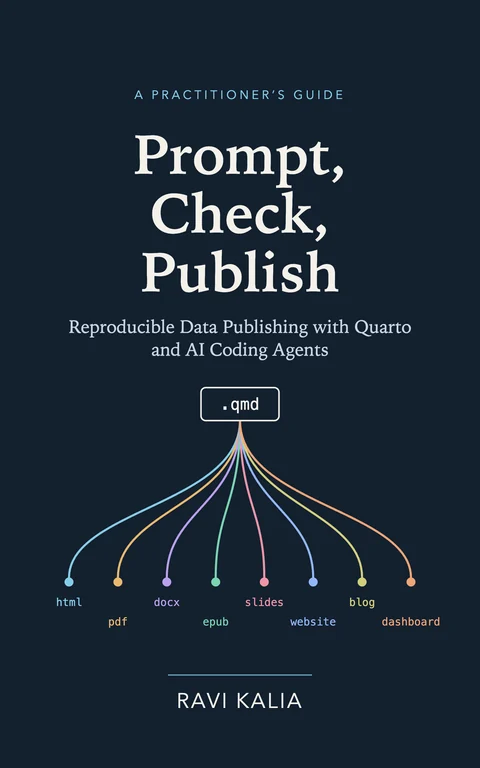
The fan on the cover is the book’s promise: one plain-text source, rebuilt into every format with one command. Each line below leads to a real one.
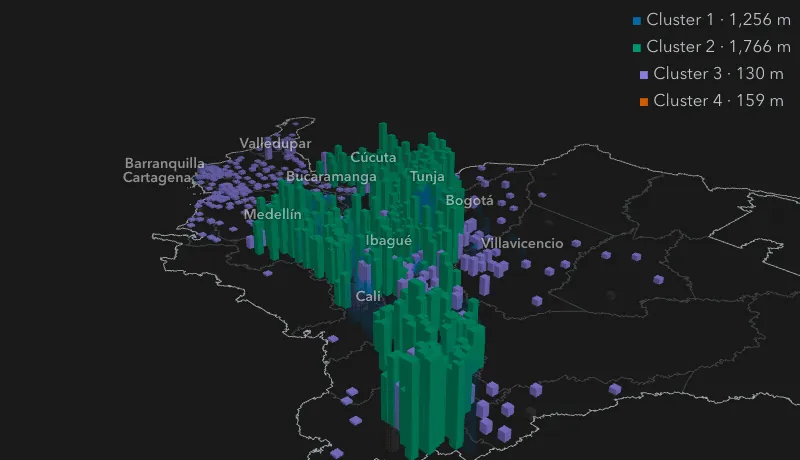
Clustered urban zones as columns at their head towns' altitude, coloured by cluster, tilting up and flying into the highlands.
Part V · Colombia
Drinking-water risk in Colombia
1,122municipalities and areas, every one of DANE’s DIVIPOLA entries, urban and rural, 2010–2023
Group municipal zones into kinds with k-means, compare health and education between them, and publish the analysis as a report, slides, a blog post and a website, all from one analysis script.
This page is a Quarto document. When it is built, code reads the book’s data, chapter list and cover, so every number on it, the contents below and the fan of formats above come from the book’s source, not from typing. Change the data, rebuild, and the page changes with it. This is the function behind the London number:
def london_top() -> dict:
    import pandas as pd

    att = pd.read_csv(ROOT / "examples/london/data/attractions.csv")
    visits_col = next(c for c in att.columns if c.startswith("visits_"))
    top = att.loc[att[visits_col].idxmax()]
    return {"name": top["attraction"], "visits": int(top[visits_col]),
            "year": visits_col.removeprefix("visits_"), "n": len(att)}
Anyone who works with data or code and needs to share the results. If you already use a terminal and Git, the fast path takes you from there to a report in three formats in under an hour; if not, the route from zero sets up your computer first. No programming is assumed: the book explains the Python the agent writes, but you do not have to write it.
What you need
Three things
A computer on which you can install software: Windows, Mac or Linux.
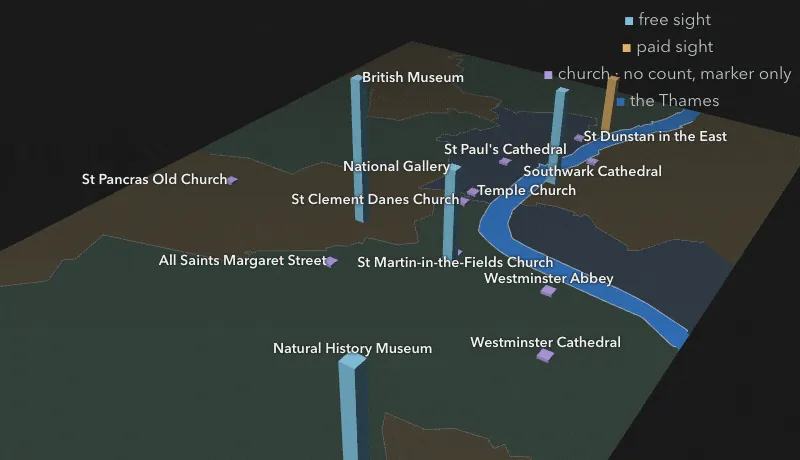
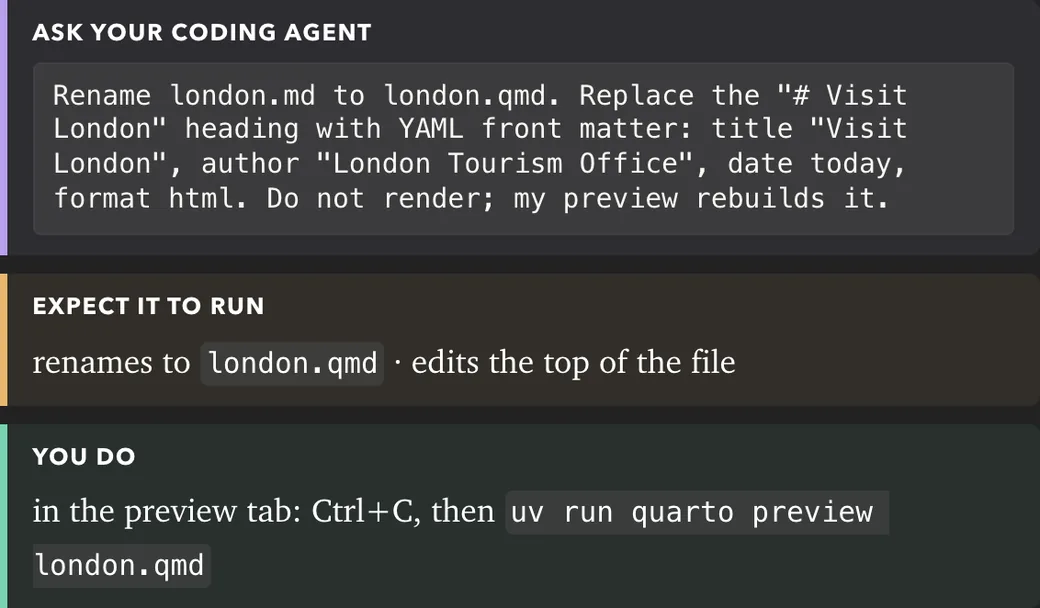
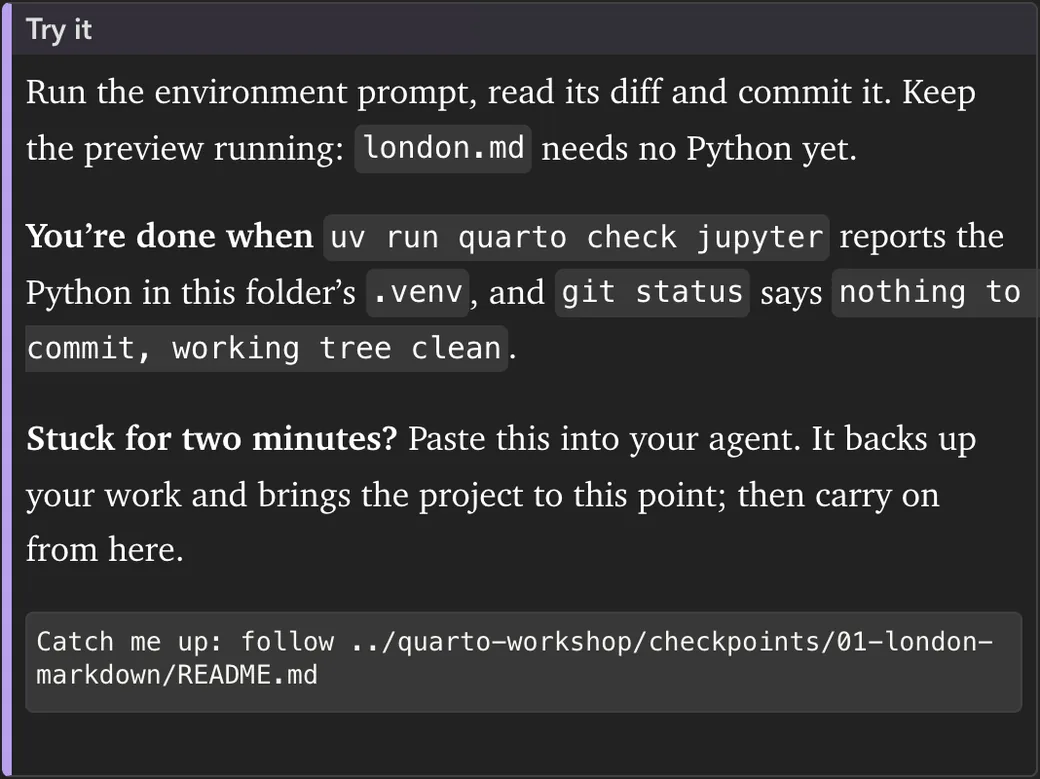
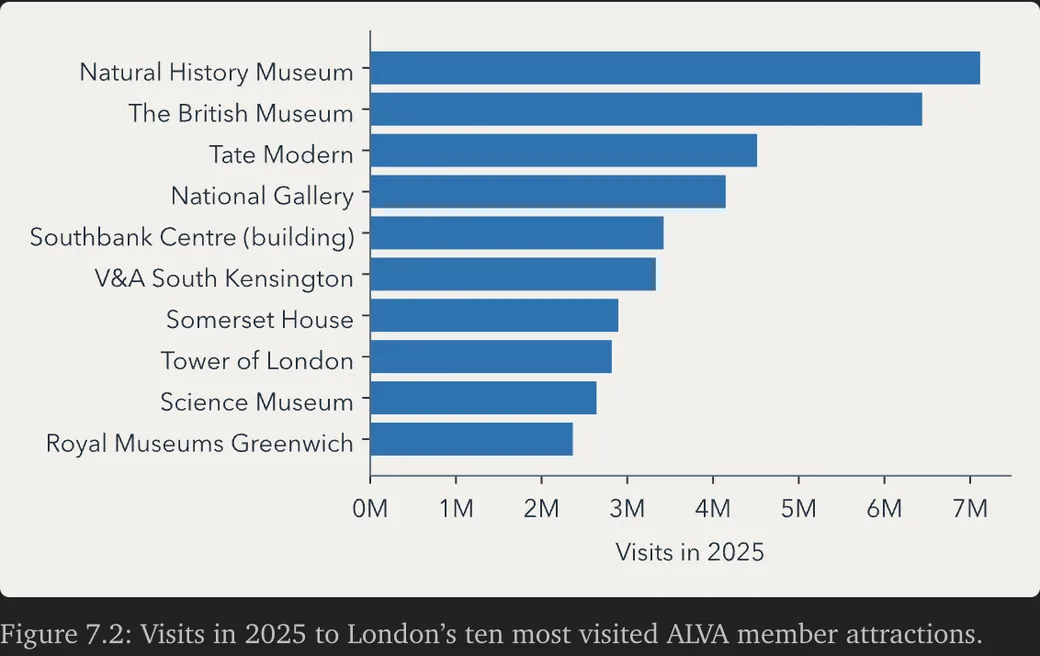
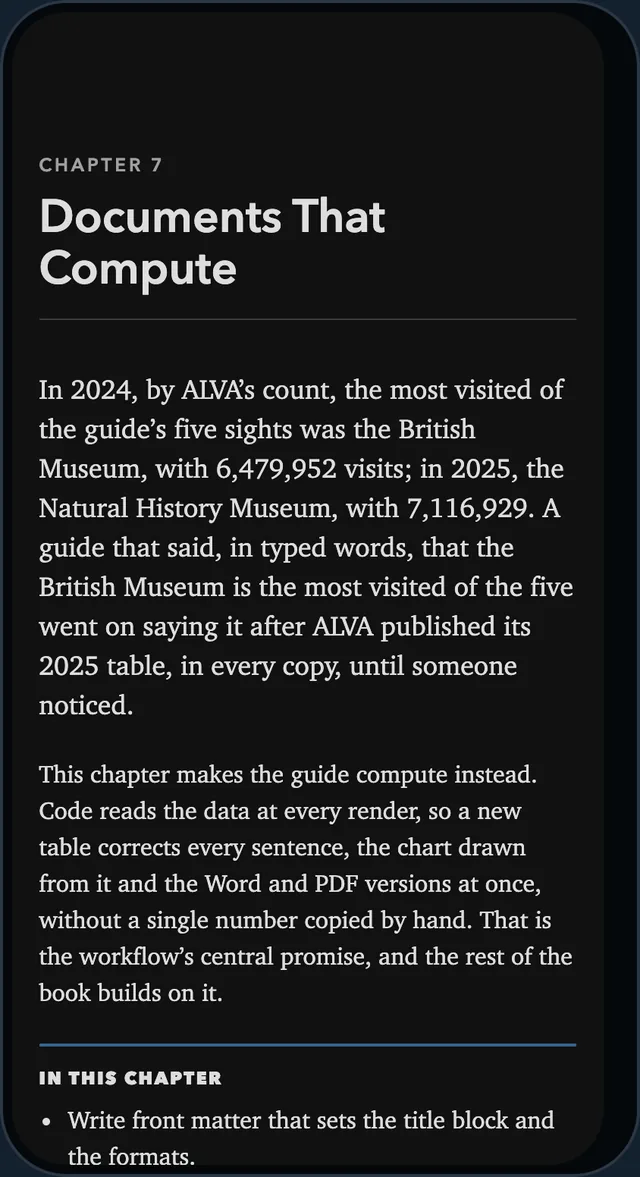
Every hands-on step is a three-part box: the exact prompt to give your agent, what it will probably run, and the few things only you can do.Stuck for two minutes? One line to your agent brings the project to the chapter's checkpoint, and you carry on from there.Visits in 2025 to London's ten most visited ALVA member attractions. Every chart has a caption and alt text, which say different things.Alt text: Horizontal bar chart of 2025 visits to ten London attractions, longest bar at the top: the Natural History Museum is highest and Royal Museums Greenwich lowest.The EPUB at night on a phone. Chapter 7 opens with the same 7,116,929 visits, computed from the same file.
The workshop
Run it as a six-hour workshop
The book is the written edition of a six-hour, hands-on workshop. Its slides are online, and its worked examples and catch-up checkpoints are in the repository, so you can follow along alone or teach it.
Ravi Kalia holds a PhD in statistical machine learning from the University of Oxford and has spent twenty years working with data, in several industries and on many continents.
This book is the written edition of Ravi’s hands-on Quarto workshop. The workshop’s slides are online, and its worked examples and catch-up checkpoints are in its GitHub repository.
Yes. Download the EPUB or read the website edition: there is no sign-up and no email to give.
How do I open it on my phone?
In LinkedIn’s, Instagram’s or another app’s browser, the download often fails. Open this page in Safari or Chrome first: tap ⋯ or ⋮, then Open in browser.
On an iPhone or iPad: once it has downloaded, open it (Safari: tap ⬇ beside the address; Chrome: tap Open in… at the bottom). If Books does not open, use the share sheet (Safari: tap Share first): tap Books in the row of apps or, if it is not there, swipe that row to its end and tap More.
On Android: you need a reading app such as Google Play Books (free). Once it has downloaded, tap Open. If the phone cannot open it, find the book in Files → Downloads, long-press it, then Open with → Play Books.
Which agent do I need?
One coding agent. Claude Code needs a Pro, Max, Ultra, Team, Enterprise or Console account; Codex a ChatGPT sign-in or an API key; Antigravity a Google account (checked 2026-11-18). Chapter 2 explains how to choose, and what a conversation costs.
Does it work on Windows?
Yes: Windows, Mac or Linux. On Windows you first install Ubuntu with WSL; Appendix A and the workshop’s Windows page take you through it, one checked step at a time.
How current is it?
The first edition, of November 2026, was checked with Quarto 1.10.20. Prices, versions, screens and plans are given with the date they were checked, and will change.
Can I teach with it?
Yes: teach from the free book and slides, link to them, and follow Appendix I to run the workshop. To copy or adapt the material, ask the author first.
How was it written?
With an AI coding agent, as the book teaches. From the book’s AI usage statement:
This book was written with Claude Code (Claude Opus 5.5), which drafted the chapters, code, diagrams and media scripts and rendered both editions, adapting the workshop slides, which were themselves written with Claude Code (Claude Opus 5.5, Sonnet 5.5, Opus 5 and Fable 5.1). Every number drawn from the projects’ data is computed from that data when the book is built; prices, timings and other facts that change are cited with the date they were checked. The author directed the work and takes full responsibility for the content.
Get the book
Free. The EPUB for your e-reader, or the website edition with the live 3-D scenes.
In LinkedIn’s, Instagram’s or another app’s browser, the download often fails. Open this page in Safari or Chrome first: tap ⋯ or ⋮, then Open in browser.
On an iPhone or iPad: once it has downloaded, open it (Safari: tap ⬇ beside the address; Chrome: tap Open in… at the bottom). If Books does not open, use the share sheet (Safari: tap Share first): tap Books in the row of apps or, if it is not there, swipe that row to its end and tap More.
On Android: you need a reading app such as Google Play Books (free). Once it has downloaded, tap Open. If the phone cannot open it, find the book in Files → Downloads, long-press it, then Open with → Play Books.